
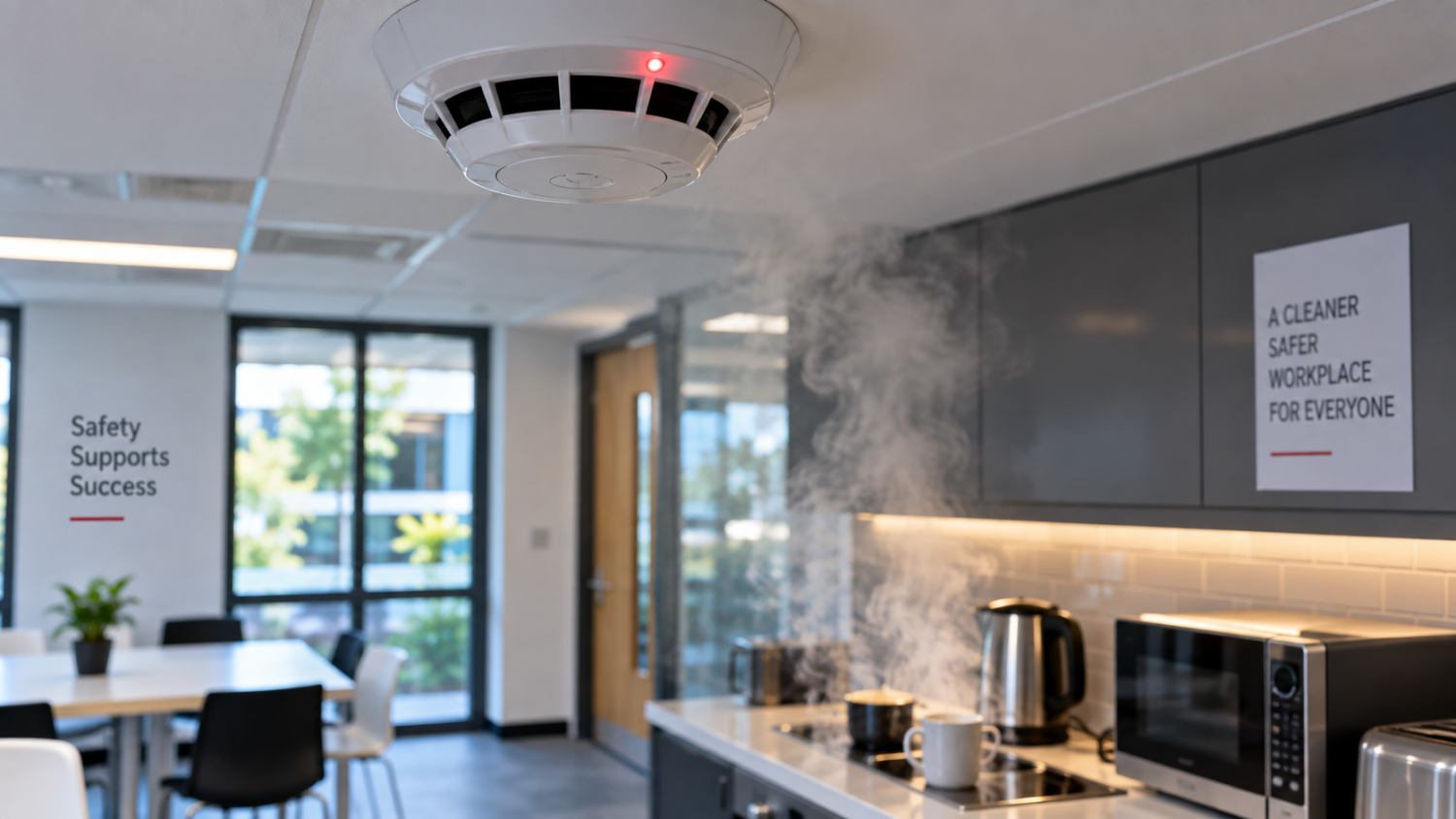
If your commercial fire alarm keeps activating when there is no fire, it should not simply be treated as an annoying fault and repeatedly reset. False alarms can be caused by cooking fumes, steam, dust, aerosols, unsuitable detector types, poor detector positioning, building work, equipment faults or inadequate maintenance.
The important part is finding out why the alarm is activating. Repeated false alarms can disrupt a business, reduce people’s confidence in the alarm and potentially lead to occupants becoming slower to react when a genuine fire occurs.
For businesses, landlords and property managers across Horley, Reigate, Redhill, Crawley, Surrey and West Sussex, this guide explains:
- What counts as a false fire alarm
- The most common causes
- Why smoke detectors can react to steam and cooking
- How dust and building work affect detectors
- Why detector positioning matters
- How maintenance can reduce unwanted alarms
- What repeated activations could tell you about the system
- Why simply changing detectors is not always the answer
- When a fire alarm engineer should investigate
- How JPEC Fire & Security can help
What is a false fire alarm?
A false alarm is an alarm activation where there is no actual fire requiring the warning.
In commercial buildings, this can originate from automatic detectors, manual call points, equipment faults or activities taking place within the premises.
You may also hear the term unwanted fire signal used, particularly where an automatic fire alarm activation results in a signal being passed to an alarm receiving centre or fire and rescue service when there is no fire.
One accidental activation does not necessarily mean the whole system is defective. Repeated activations, however, need to be investigated.
Why are repeated false alarms a problem?
The obvious problem is disruption. Staff may have to stop working, occupants may evacuate and normal business operations can be interrupted.
There is also a more important fire-safety issue.
If people regularly hear the fire alarm when there is no fire, they can begin to assume future activations are also false alarms. Government fire-safety guidance warns that excessive false alarms can cause complacency and result in people failing to respond correctly to a genuine warning.
Every activation should therefore be taken seriously and repeated false alarms should be investigated rather than accepted as normal.
What are the most common causes of false fire alarms?
There are many possible causes, and the correct diagnosis depends on the building and system.
Common examples include:
- cooking fumes
- steam
- dust
- aerosol sprays
- smoking or vaping near detectors
- building and decorating work
- incorrect detector selection
- poor detector positioning
- contaminated detectors
- equipment faults
- accidental operation of manual call points
- changes in how a room is used
Finding the cause is important because the appropriate solution for cooking fumes can be completely different from the solution for a wiring fault or contaminated detector.
Can cooking set off a commercial fire alarm?
Yes. Cooking fumes are a common cause of unwanted fire alarm activations.
This does not necessarily mean somebody is burning food badly enough to create clouds of smoke.
A sensitive smoke detector positioned close to a kitchen, staff tea point or other cooking area may react to normal products of cooking.
Problems can also develop when the use of a room changes. For example, an area originally designed as an office or store may later have a toaster, microwave or other cooking appliance added without anybody reconsidering the nearby fire detection.
The solution should be based on the fire risk assessment and proper system design rather than simply removing the detector.
Can steam trigger a smoke detector?
Yes. Some smoke-detection technologies can react to steam or airborne particles that resemble the conditions they are designed to detect.
This can become an issue around kitchens, showers and other areas where significant amounts of steam are produced.
Repeated activations around one particular area can therefore indicate that the detector type, its location or the way the space is being used needs reviewing.
It does not mean that automatic fire detection should simply be removed from the area without an appropriate assessment.
Can aerosol sprays set off a fire alarm?
They can.
Aerosol products release fine particles into the air, and these can potentially affect some smoke detectors.
The likelihood depends on the detector technology, concentration of the aerosol, ventilation and how close the product is used to the detector.
If activations repeatedly coincide with cleaning products, deodorants, sprays or other aerosols being used, that information can be valuable when an engineer investigates the system.
Why does building work cause fire alarms?
Construction, refurbishment and decorating work can create significant amounts of dust and airborne contamination.
Drilling, sanding, cutting plasterboard and other activities can all affect automatic detection.
Hot works can present additional issues because they may create heat, smoke or fumes while also introducing a genuine fire risk.
Contractors therefore need to understand the building’s fire-safety arrangements before work begins.
Any temporary measures involving fire detection should be properly managed so that fire safety is maintained while the work takes place and the system is correctly reinstated afterwards.
Can dust inside a detector cause false alarms?
Yes. Contamination can affect the operation of detection equipment over time.
Commercial premises can expose detectors to dust, insects and other airborne contamination depending on the environment.
This is one reason why proper inspection and preventive maintenance are important.
If a particular detector begins activating repeatedly without an obvious environmental cause, its condition should form part of the investigation.
Could the wrong type of detector be installed?
Potentially.
Smoke detectors, heat detectors and multi-sensor devices respond differently to their environment.
A detector that is suitable for a clean office may not necessarily be appropriate in an area regularly exposed to cooking fumes, steam or dust.
Detector selection is therefore part of fire alarm system design.
If a building has changed use since the original system was installed, a detector that was appropriate when the system was designed may no longer suit the conditions now present.
Would changing a smoke detector to a heat detector stop false alarms?
It might reduce certain unwanted activations in an appropriate location, but detectors should not be changed simply to stop an annoying alarm.
Smoke and heat detection have different characteristics, and changing detector type can alter how quickly a developing fire is detected.
Government fire-safety guidance gives examples where a heat detector may be more appropriate following a change in room use, but this is subject to the outcome of the fire risk assessment.
A competent fire alarm professional should therefore assess why the existing detector is activating and whether a different detector is suitable.
Can poor detector positioning cause false alarms?
Yes.
Detector location can have a major effect on how the system performs.
A smoke detector installed where cooking fumes regularly travel, for example, can experience more unwanted activations than one appropriately positioned for the room and its risks.
Air movement from ventilation systems, open windows and other environmental conditions can also affect some installations.
Repeated alarms from the same area are therefore worth investigating rather than continually resetting the panel.
Can a fire alarm go off because of an electrical fault?
Yes. Not every unwanted activation is caused by smoke, steam or dust.
Fire alarm systems contain control equipment, circuits, detectors, sounders, power supplies and batteries, and faults can develop within the system.
The control panel may provide information about the affected zone, loop, device or fault depending on the type of system installed.
An engineer can use the available system information alongside testing and inspection to investigate the cause.
Repeated faults should not simply be cleared from the panel without finding out why they are occurring.
Can manual call points cause false alarms?
Yes. Manual call points can be activated accidentally or maliciously.
This can happen where a call point is particularly vulnerable to impact, positioned in an area with frequent movement of equipment or deliberately operated when there is no fire.
Suitable protective arrangements may sometimes help where accidental activation is a recurring problem.
However, manual call points need to remain accessible and usable for their intended purpose, so any change should form part of the proper fire alarm design.
Why does my fire alarm keep going off at the same time?
A repeating pattern can provide useful clues.
If activations occur around lunchtime, cooking activity may be relevant. If they occur during cleaning, aerosols or dust could be involved. If they coincide with contractors working, building activity may need investigation.
Other patterns may relate to environmental conditions or equipment behaviour.
Recording when an activation occurs, which device or zone triggered it and what was happening in the building at the time can help identify recurring causes.
Should false alarms be recorded?
Yes. Keeping an accurate fire alarm log helps build a history of the system.
Records can show whether activations are isolated events or part of a recurring pattern.
Useful information can include the date and time, the device or zone involved, the apparent cause and any remedial action taken.
Government fire-safety guidance recommends recording fire alarm tests, false alarms and maintenance.
Those records can also be useful during servicing because the engineer can investigate areas that have repeatedly caused problems.
Will servicing stop false alarms?
Good maintenance can help prevent false alarms caused by contamination, deterioration and equipment problems, but servicing cannot automatically eliminate every unwanted activation.
If the underlying problem is inappropriate detector selection, room use or environmental conditions, the system may require further investigation or modification.
This is why JPEC Fire & Security looks at the cause of repeated activations rather than treating a service visit as simply a box-ticking exercise.
The fire alarm needs to suit the building as it is actually being used.
How often should a commercial fire alarm be serviced?
Routine user testing and professional servicing are separate activities.
Government guidance for workplaces recommends weekly testing of fire-warning systems, normally using a different manual call point on successive tests, alongside periodic maintenance by a competent specialist.
Government fire-safety risk-assessment guidance also refers to six-monthly servicing and preventive maintenance by a competent person with specialist knowledge of fire-warning and automatic detection systems.
The appropriate maintenance arrangement should reflect the system, premises and applicable recommendations.
Could repeated false alarms mean the building has changed?
Yes, and this is easy to overlook.
A fire alarm system may have been properly designed when it was installed, but buildings evolve.
An office can become a kitchen. A storage room can become a workshop. New partitions can be installed. Ventilation can change. Equipment can be moved and new working processes introduced.
When the building changes, the original fire alarm design should not automatically be assumed to remain appropriate.
Significant changes should also prompt consideration of the fire risk assessment.
Should I just silence and reset the alarm?
No. A fire alarm activation should be treated according to the building’s established emergency procedures.
People should not assume an alarm is false simply because previous activations have turned out to be unwanted alarms.
Once it has been established through the appropriate procedure that there is no fire, the cause of the activation should be investigated.
If the same detector or zone repeatedly activates, arranging professional investigation is preferable to repeatedly resetting the system and hoping the problem disappears.
Should I disconnect a detector that keeps causing problems?
No. Fire detection should not simply be disconnected, covered, removed or permanently isolated because it is causing unwanted alarms.
Doing so could leave an area without the detection identified as necessary for the building.
If a detector appears to be causing repeated false alarms, a competent fire alarm engineer should investigate why.
The appropriate solution could involve maintenance, repositioning, replacement, a different detector technology or changes to how the area is managed, depending on the circumstances.
What should a fire alarm engineer investigate?
The investigation depends on the symptoms and type of system, but it can include reviewing:
- the fire alarm event history
- which detectors or zones are activating
- detector condition and contamination
- environmental conditions
- detector type and positioning
- recent building changes
- electrical and system faults
- maintenance history
- changes in room use
- patterns in previous false alarms
Finding the underlying cause is more useful than simply replacing equipment without knowing why the problem developed.
What if the fire alarm is connected to an alarm receiving centre?
Monitored systems require additional management because an activation may be transmitted beyond the premises.
Testing and maintenance arrangements should account for the connection so planned testing does not create an unnecessary external response.
Procedures for investigating activations and communicating with the monitoring provider should be clearly understood by the people responsible for the premises.
Fire and rescue service responses to automatic fire alarm signals can vary between services and circumstances, so businesses should understand the arrangements relevant to their premises rather than assuming every automatic signal will receive the same response.
Can modern fire alarm technology reduce false alarms?
Modern detector technology can provide more sophisticated ways of analysing conditions within a building.
Multi-sensor detectors, for example, can use more than one sensing method depending on the equipment and system design.
However, better technology does not compensate for poor design.
The correct detector still needs to be selected for the environment, positioned appropriately, commissioned correctly and maintained throughout its working life.
Upgrading equipment can therefore be part of the solution, but it should follow an assessment of why the existing system is generating unwanted alarms.
When should I call a fire alarm engineer?
If your commercial fire alarm repeatedly activates without an identifiable fire condition, develops recurring faults or continually shows problems associated with the same device or area, professional investigation is sensible.
You should also seek advice if the building has undergone significant alterations or changes of use that may have affected the original detection design.
The aim is not simply to make the alarm quieter. It is to maintain reliable fire detection while reducing avoidable activations.
JPEC Fire & Security can help
JPEC Fire & Security installs, tests, services, maintains and investigates fire alarm systems for businesses, landlords, property managers and organisations across Horley, Reigate, Redhill, Crawley, Surrey, West Sussex and surrounding areas.
If your fire alarm keeps activating, we can investigate the affected system, detectors and environment to help identify the underlying cause rather than simply resetting the panel.
Where appropriate, this can include reviewing detector selection and positioning, investigating faults, replacing defective equipment, maintaining existing systems or recommending modifications where the building or its use has changed.
JPEC Fire & Security can also provide fire risk assessments, emergency lighting, AOV and smoke-control systems, access control, CCTV and intruder alarm services where required.
Reliable fire detection is about achieving the right warning when it is needed while reducing avoidable activations that disrupt the building and undermine confidence in the system.
To arrange fire alarm fault-finding, servicing or a system assessment, contact JPEC Fire & Security.
This article provides general information and is not a substitute for a premises-specific fire risk assessment, fire alarm system design or professional inspection. Do not disable or alter fire detection equipment to address repeated alarms without appropriate competent advice.