The type of fire alarm system your business needs depends on the building, how it is used, who occupies it and the findings of your fire risk assessment. There is no single fire alarm specification that is automatically right for every shop, office, warehouse, workshop or commercial property.
Some premises may require primarily manual warning, while others need automatic detection across particular areas or throughout much more of the building. The system may also need to interact with other fire-safety equipment, depending on the premises and its fire strategy.
For businesses, landlords and property managers across Horley, Reigate, Redhill, Crawley, Surrey and West Sussex, this guide explains:
- How fire alarm requirements are determined
- The difference between manual and automatic detection
- What fire alarm categories mean
- The difference between conventional and addressable systems
- How smoke and heat detectors differ
- When visual alarm devices may be needed
- How building size and use affect the design
- Why your fire risk assessment matters
- What happens during professional design and installation
- How JPEC Fire & Security can help
Does every business need the same type of fire alarm?
No. Fire alarm requirements should reflect the risks and circumstances of the individual premises.
A small ground-floor shop with a straightforward layout presents different considerations from a multi-storey office, warehouse, industrial unit or building containing several separate occupiers.
Factors that can affect the required arrangements include:
- the size and layout of the building
- the number of floors
- how the premises are used
- the number of occupants
- people who may need assistance to evacuate
- areas that may be unoccupied for periods of time
- escape routes
- the nature of the fire risks
- existing fire precautions
- the findings of the fire risk assessment
The starting point should therefore be understanding the premises and its fire-safety requirements rather than simply selecting alarm equipment from a catalogue.
Is a fire alarm a legal requirement for a business?
Fire-safety law does not simply state that every business must install exactly the same electrical fire alarm system.
In England, the responsible person for business and other relevant non-domestic premises has duties under the Regulatory Reform (Fire Safety) Order 2005, as amended. These include carrying out and regularly reviewing a fire risk assessment and putting appropriate fire-safety measures in place.
Those measures include ensuring that people can be adequately warned if a fire occurs.
For some very small and straightforward premises, relatively simple warning arrangements may be sufficient if everyone can be alerted immediately. In larger, more complex or higher-risk premises, an electrical fire detection and warning system is much more likely to be necessary.
The appropriate provision should be determined from the actual premises and its fire risk assessment.
Who is the responsible person?
The term responsible person has a specific meaning under fire-safety legislation.
Depending on the premises, this can include an employer, owner, landlord, occupier or another person with control of the premises.
There can also be more than one responsible person in a shared building, in which case relevant parties need to cooperate and coordinate their fire-safety arrangements.
Appointing a contractor or fire-risk assessor to provide professional assistance does not simply transfer the responsible person’s legal duties to that contractor.
If you are unsure who holds particular legal responsibilities for your premises, appropriate professional or legal advice should be obtained.
Why does the fire risk assessment come first?
The fire risk assessment helps establish the risks within the premises and whether the existing fire precautions are appropriate.
It considers issues such as potential ignition sources, combustible materials, people at risk, escape arrangements and existing fire-safety measures.
Fire detection and warning is one part of that wider assessment.
For example, automatic detection may become particularly important where a fire could develop in an area without being noticed quickly enough for occupants elsewhere in the building to escape safely.
This is why JPEC Fire & Security assesses the premises and its requirements before recommending a system.
What is a manual fire alarm system?
A manual fire alarm relies on someone discovering a fire and raising the alarm.
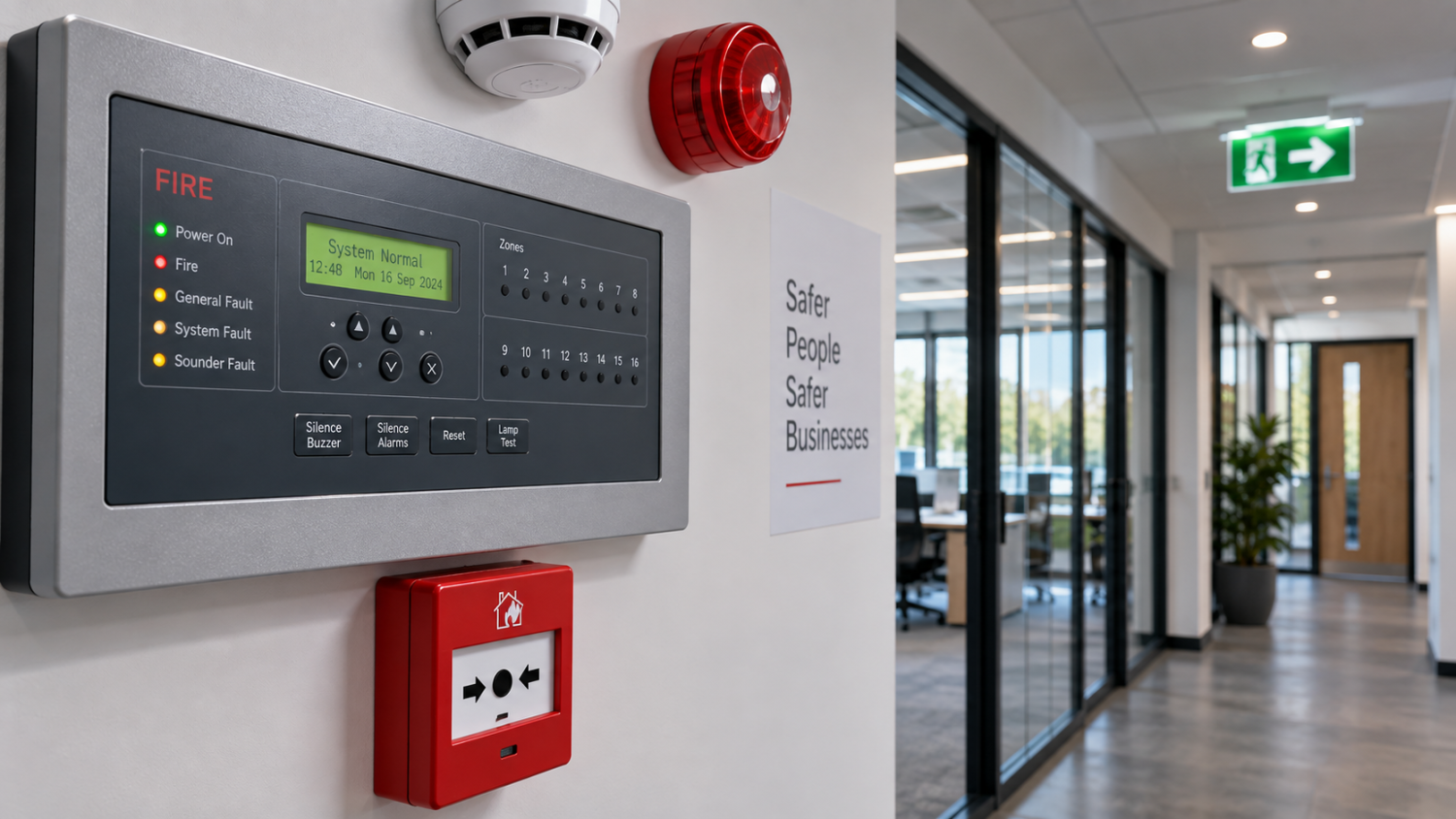
In an electrical system, this commonly involves manual call points positioned around the building, connected to sounders and a fire alarm control panel.
When someone operates a call point, the system activates the warning throughout the relevant areas of the premises.
Manual warning may form an important part of a commercial fire alarm system even where automatic detectors are also installed.
Whether manual warning alone could ever be sufficient depends on the individual premises and risk assessment.
What is automatic fire detection?
Automatic fire detection uses detectors to identify signs associated with a developing fire without relying solely on somebody noticing it first.
Depending on the system and environment, this may include smoke, heat or multi-sensor detection.
Automatic detection can be particularly important where areas are sometimes unoccupied, people work alone or a fire could develop without being immediately visible to occupants.
The type and extent of detection should be designed for the actual building and its risks.
What do fire alarm categories mean?
Fire alarm categories describe the objective and extent of protection provided by a fire detection and alarm system.
For non-domestic premises, BS 5839-1 uses category designations including M, L and P systems.
These should not be treated as a simple ranking where one category is automatically “better” than another. They describe different objectives and levels of coverage.
The correct category should be established from the fire-safety requirements of the building.
What is a Category M fire alarm?
Category M refers to a manual fire alarm system.
The alarm is raised by people within the premises using manual call points rather than automatic detectors being relied upon to identify the fire.
Manual call points and suitable warning devices form a fundamental part of many commercial systems.
However, whether manual warning alone is sufficient depends on how quickly a fire is likely to be discovered and whether everybody can be warned in enough time to escape safely.
What are Category L fire alarm systems?
Category L systems are intended primarily to protect life by providing automatic fire detection.
Different L categories provide different extents of automatic detection.
The appropriate category depends on the fire strategy and risks within the premises rather than simply the size of the client’s budget.
A building may need automatic detection on escape routes, within particular higher-risk areas or across a much greater proportion of the premises.
The design should therefore be based on the required fire-safety objective.
What are Category P systems?
Category P systems are primarily concerned with property protection.
The objective is different from a Category L life-safety system, although a particular installation may have requirements relating to both life and property protection.
Property-protection requirements may also be influenced by insurers, business-continuity considerations or the value and importance of the building and its contents.
An insurer’s requirement should be distinguished from a statutory fire-safety duty, even where both affect the final system design.
What is the difference between a conventional and addressable fire alarm?
Conventional and addressable systems differ in how devices are connected and how the system identifies where an activation or fault has occurred.
A conventional system generally divides the premises into zones. When a detector or call point activates, the control panel identifies the affected zone.
An addressable system allows individual devices to have their own address, enabling the panel to provide more precise information about the device involved.
That can be particularly useful in larger or more complex buildings where quickly locating an activation or fault is important.
Does a bigger building automatically need an addressable system?
Not simply because of its floor area.
Building size is relevant, but layout, complexity, occupancy, system requirements and the required cause-and-effect operation also matter.
A relatively large but straightforward property can present different design considerations from a smaller building containing multiple areas, floors or occupiers.
JPEC Fire & Security can assess the building and explain whether conventional or addressable technology is more appropriate for the project.
Should I use smoke detectors or heat detectors?
The correct detector depends on the environment and the type of fire that needs to be detected.
Smoke detection can provide early warning of many developing fires, but it is not appropriate to install the same detector type indiscriminately throughout every building.
Areas containing steam, dust, cooking activity or other environmental conditions may require a different approach to reduce unwanted alarms while still providing suitable fire detection.
Heat detectors and multi-sensor devices can form part of the design where appropriate.
Detector selection should therefore be carried out as part of the system design rather than chosen simply on appearance or price.
What is a multi-sensor fire detector?
A multi-sensor detector uses more than one sensing method to help identify conditions associated with fire.
Depending on the product, this could involve different combinations of smoke, heat or other sensing technologies.
These devices can be useful in appropriate environments, but they are not automatically the correct detector for every room.
The detector needs to be selected and configured according to the system design, manufacturer requirements and conditions within the building.
What are visual alarm devices?
Visual alarm devices provide a visible warning when the fire alarm operates.
They may be required where an audible warning alone would not adequately alert everyone who needs to respond.
This can be relevant in areas with high background noise and where people may not reliably hear conventional sounders.
The needs of people with disabilities should also be considered as part of the fire risk assessment and evacuation arrangements.
The required solution depends on the building and occupants rather than simply installing flashing devices everywhere.
Does the fire alarm need to be heard everywhere?
The warning arrangements need to be suitable for the people and areas they are intended to protect.
Simply having sounders installed does not prove that an alarm will provide an adequate warning throughout an occupied building.
Doors, partitions, machinery, background noise and the layout of the premises can all influence audibility.
Professional design, commissioning and testing are therefore important parts of a fire alarm installation.
Can a fire alarm control other systems in the building?
Yes. Depending on the fire strategy and building design, a fire alarm system may need to interact with other systems.
This can potentially include:
- automatic opening vents and smoke-control systems
- door-release arrangements
- access-control systems
- plant shutdown arrangements
- other building fire-safety equipment
The required cause-and-effect operation should be established during design and properly tested during commissioning.
Interfaces should not be added or altered casually because they can affect how the building responds during a fire.
What if my existing fire alarm is old but still works?
Age alone does not automatically mean a complete fire alarm system needs replacing.
However, an older system may justify assessment if equipment has become unreliable, replacement parts are obsolete, faults are becoming frequent or the building has changed significantly since the system was designed.
Changes to occupancy, internal layout or use of the premises can also affect whether the original detection and warning arrangements remain appropriate.
JPEC Fire & Security can inspect existing systems and explain whether maintenance, alteration, extension or replacement should be considered.
Do I need to replace the fire alarm when refurbishing my building?
Not automatically, but refurbishment is a sensible time to review the existing system.
Moving walls, creating new rooms, changing escape routes or altering how areas are used can affect detector coverage, call-point positions, sounder performance and zoning.
New ceilings and finishes can also affect existing devices and cabling.
The fire alarm should therefore be considered during the refurbishment design rather than after the building work has already been completed.
What happens during a professional fire alarm survey?
The first stage is understanding the building and what the system needs to achieve.
Depending on the project, this may include reviewing:
- building layout
- occupancy
- escape routes
- existing detection
- manual call points
- sounders and visual warning
- existing control equipment
- the fire risk assessment
- other systems requiring an interface
- future alterations to the premises
The findings can then be used to develop an appropriate system specification.
What happens after installation?
A fire alarm installation should be properly inspected, tested and commissioned before handover.
The client should understand how to operate the system and what ongoing testing and maintenance arrangements are required.
Relevant documentation should also be provided and retained with the building’s fire-safety records.
Installation is therefore not the end of the process. The system needs to remain suitable and operational throughout its service life.
How often does the fire alarm need servicing?
Fire alarm systems need ongoing inspection and maintenance so faults, damaged devices, battery problems, contamination and other issues can be identified.
The appropriate servicing arrangements depend on the system and applicable requirements.
JPEC Fire & Security already has a dedicated guide explaining fire alarm servicing in more detail, so building owners and responsible persons should consider maintenance as part of the long-term management of the system rather than only arranging attention when a fault appears.
JPEC Fire & Security can help
JPEC Fire & Security designs, installs, commissions, tests, services and maintains fire alarm systems for businesses, landlords, property managers and organisations across Horley, Reigate, Redhill, Crawley, Surrey, West Sussex and the surrounding areas.
We can assess your premises, existing fire precautions and system requirements before recommending an appropriate solution.
Depending on the building, this can include conventional or addressable fire alarm systems, smoke and heat detection, multi-sensor devices, manual call points, sounders, visual alarm devices and appropriate interfaces with other fire-safety systems.
JPEC Fire & Security also provides fire risk assessments, emergency lighting, AOV and smoke-control systems, CCTV, intruder alarms and access-control services where required.
Whether you are planning a new system, refurbishing a building or reviewing an existing installation, we can explain the available options and the reasons behind the recommended design.
To discuss a fire alarm survey or system design, contact JPEC Fire & Security.
This article provides general information and is not a substitute for a property-specific fire risk assessment, fire strategy, system design or legal advice. Fire alarm requirements should be confirmed for the individual premises by appropriately competent professionals.