
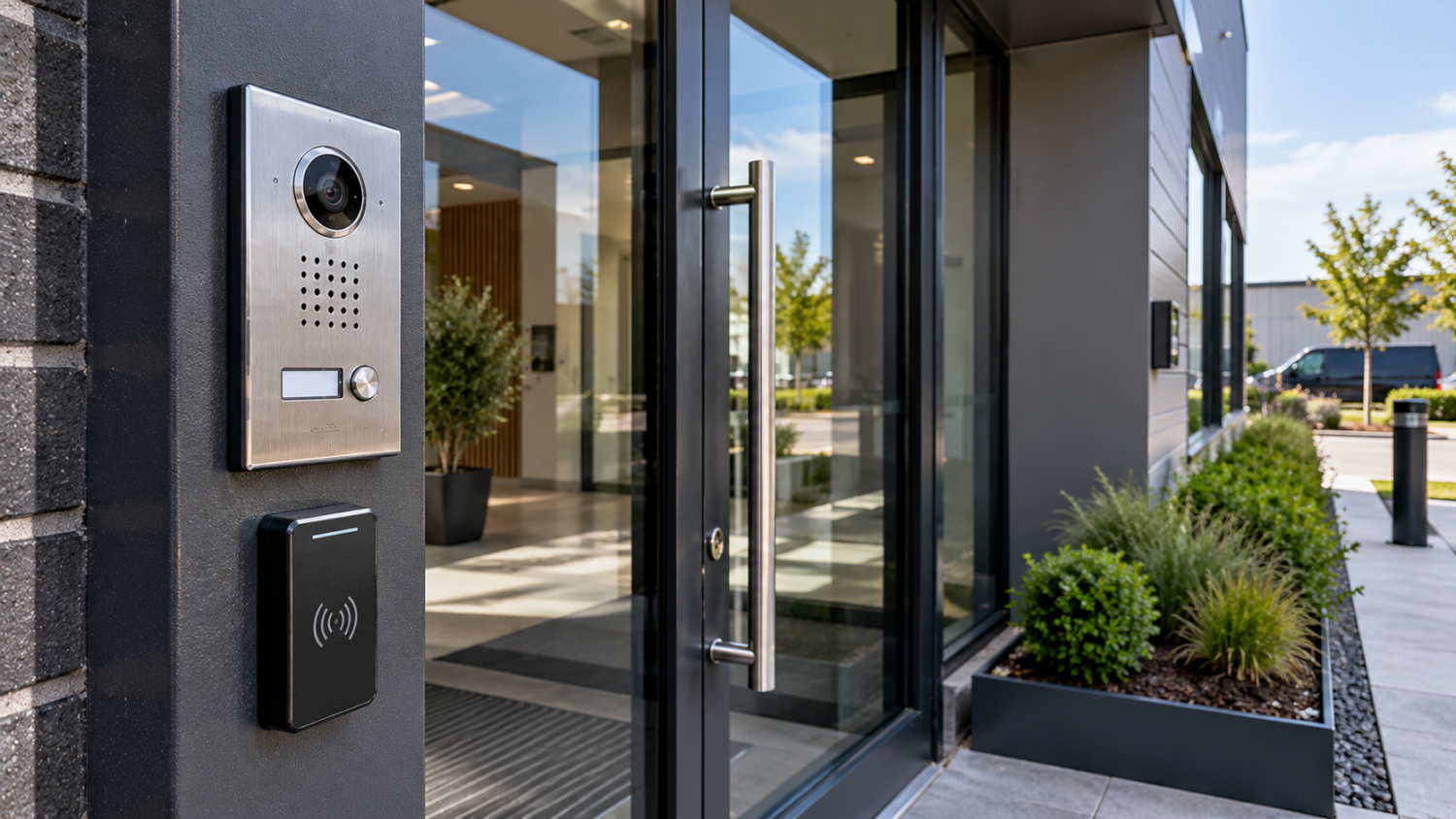
A door entry system allows someone inside a building to identify or communicate with a visitor before allowing them through a controlled entrance. Depending on the system, this might use an audio intercom, video camera, keypad, access fob, mobile app or a combination of several technologies.
Door entry systems can be used in apartment blocks, offices, commercial premises, gated sites and other buildings where simply leaving an entrance unlocked is not appropriate.
The right system depends on the building, the number of users, how visitors should gain access and the level of security required. This guide explains:
- How door entry systems work
- The difference between audio and video entry
- How fobs and keypads can be incorporated
- When door entry and access control should work together
- What to consider for flats and communal entrances
- How commercial door entry systems differ
- What happens during a power cut
- What should be considered before installation
How does a door entry system work?
A basic door entry system creates a controlled way for visitors to request access to a building.
A visitor might press a call button outside the entrance. Someone inside can then speak to them through an intercom or, with a video system, see them on a screen before deciding whether to release the door.
The door itself is normally controlled using suitable locking hardware connected to the entry or access-control system.
More advanced installations can incorporate multiple entrances, several internal users, electronic access credentials and remote management.
What is the difference between door entry and access control?
The two systems are closely related but perform slightly different jobs.
Door entry is generally focused on visitors. Someone arrives, requests access and an authorised person decides whether to let them in.
Access control is primarily concerned with allowing authorised users to enter using a credential such as a fob, card, code or other approved method.
A commercial building might therefore use a video intercom for visitors while employees use individual access-control credentials.
Combining the two can create a more practical entrance than relying on one method for everyone.
What is an audio door entry system?
An audio entry system allows the occupant and visitor to speak to each other before the door is released.
These systems are commonly associated with flats and communal entrances but can also be used in offices and other commercial properties.
Audio systems can be a practical choice where visual identification is not required and the entrance can be adequately managed through voice communication.
The appropriate arrangement depends on the building and security requirements.
What is a video door entry system?
A video door entry system adds a camera at the entrance so the person receiving the call can see the visitor.
This provides another way to verify who is requesting access before the entrance is released.
Depending on the system, video may be displayed on a dedicated internal monitor or through compatible networked equipment.
Camera positioning is important. A camera that provides a poor view of the person standing at the entrance may add little practical value.
Lighting around the entrance should also be considered because it can affect image quality.
Are video doorbells the same as a proper door entry system?
Not necessarily.
A domestic video doorbell can provide useful visitor notification and video communication, but a complete door entry system may also control an electrically secured entrance.
Apartment blocks and commercial premises can have more complicated requirements involving multiple occupants, controlled doors, exit arrangements and integration with other building systems.
A consumer video doorbell should therefore not automatically be treated as a substitute for a properly designed communal or commercial entry system.
Can residents use a fob instead of calling the intercom?
Yes, where the system is designed to provide electronic access for authorised users.
Residents or employees can be issued with individual credentials, commonly cards or fobs, allowing them to enter without using the visitor intercom.
This also means a lost credential can potentially be removed from the system rather than requiring a mechanical lock and every physical key to be replaced.
The exact functionality depends on the access-control equipment being used.
Are keypads a good option?
Keypads can be useful, but they need to be considered in relation to how the entrance will be managed.
A shared code is easy to distribute, but it can also be passed to people who should no longer have access.
For buildings where individual accountability is important, individually managed credentials may provide greater control than one code shared between many users.
Some installations combine a keypad with cards, fobs or other access methods.
What happens if somebody loses an access fob?
One advantage of an electronically managed access-control system is that an individual credential can usually be removed from the authorised user database.
A replacement credential can then be issued without changing every user’s access.
This is particularly useful in apartment buildings and businesses where occupants or employees change regularly.
Good administration is still important. If credentials are issued but nobody keeps track of who has them, the security benefit can gradually be reduced.
Can you see who has entered the building?
Some access-control systems can maintain event records showing when particular authorised credentials were used.
The available information depends on the system and how it has been configured.
Organisations using access records should also consider their responsibilities where information relates to identifiable individuals.
Access logging should therefore be implemented for a legitimate operational or security purpose rather than collecting unnecessary information simply because the technology allows it.
Can door entry work with CCTV?
Yes. Door entry, access control and CCTV can form part of a wider security system.
For example, CCTV can provide wider coverage of a building entrance while the video intercom provides a closer view of the person requesting access.
The systems do not necessarily need to perform the same function.
Designing them together can help avoid poorly positioned cameras or duplicated equipment.
Where CCTV records identifiable people, appropriate UK data protection and privacy requirements should also be considered.
What is best for an apartment block?
There is no single system that suits every block of flats.
A typical arrangement might provide a communal entrance panel for visitors, individual call points or monitors for residents and electronic credentials for occupants.
The design should consider:
- the number of flats
- the number of entrances
- how visitors should call residents
- whether video is required
- how residents gain access
- how credentials will be managed
- the existing door and locking arrangement
- fire and escape requirements
Existing blocks can also present challenges where cabling routes are limited or older entry equipment is being replaced.
What about offices and commercial buildings?
Commercial buildings may need to manage employees, contractors, deliveries and visitors differently.
Staff might enter using individual access credentials while visitors communicate with reception through an intercom.
Different doors can also require different levels of access.
An employee may be authorised to enter the main office but not a plant room, server room or restricted storage area.
This is where combining door entry with a properly designed access-control system becomes particularly useful.
Can door entry systems be used on gates?
Yes. Intercom and access-control equipment can be used as part of an automated or controlled gate installation where the equipment and overall design are suitable.
The greater distance between the gate and the building can affect cabling, communications and power requirements.
The location may also expose external equipment to harsher weather conditions than a sheltered building entrance.
The gate equipment and any safety systems associated with its movement need to be considered as part of the wider installation.
Can you answer a door entry system from your phone?
Some modern systems can provide app or network-based functionality that allows authorised users to receive calls or manage aspects of the system remotely.
This can be useful for certain businesses, managed buildings or properties where nobody is permanently positioned at reception.
However, remote functionality creates additional considerations around network availability, account security and system administration.
It should be selected because it solves a genuine requirement rather than simply because an app is available.
What happens to a door entry system during a power cut?
This depends on the equipment and how the system has been designed.
Electronic locking, access-control controllers, intercom equipment and network devices all require power.
Backup power may be incorporated where continued operation is required during a mains failure.
However, entrance security cannot be considered independently from safe escape.
The behaviour of controlled doors during a power failure or fire condition needs to suit the building, locking method, escape strategy and applicable fire-safety requirements.
Do access-controlled doors unlock when the fire alarm activates?
Some controlled doors may need to release as part of the building’s fire strategy, but this should not be assumed for every door or every installation.
The correct behaviour depends on the door, its purpose, the locking arrangement and the fire-safety design of the premises.
Fire alarm and access-control interfaces should therefore be designed deliberately rather than improvised after both systems have already been installed.
JPEC Fire & Security can consider access control alongside the wider fire and security systems within the building.
Can an existing door be converted to electronic access?
Often, but the existing door needs to be assessed first.
The locking hardware, frame, door construction and how people safely exit all affect the available options.
Simply adding an electronic lock to a door without considering the complete arrangement can create usability or safety problems.
Where the entrance forms part of an escape route, the fire-safety implications are particularly important.
What should be checked before installing a door entry system?
A survey should establish how the building currently operates and what the new system needs to achieve.
Important considerations can include:
- number of entrances
- number of users
- visitor arrangements
- existing doors and locks
- cable routes
- power supplies
- network availability
- internal call locations
- external weather exposure
- fire and escape arrangements
- future expansion
A good system should fit the way the building is actually used rather than making everyday access unnecessarily complicated.
Can an old door entry system be upgraded?
Potentially.
Older systems can develop problems with call buttons, handsets, cameras, power supplies, locking equipment and cabling.
Whether the best solution is repair, partial upgrade or replacement depends on the condition and compatibility of the existing equipment.
If a building is also considering new CCTV or access control, it may be worth reviewing the systems together rather than replacing each one independently.
Does a door entry system need maintenance?
Yes. Like other electronic security equipment, door entry and access-control systems should be kept in working condition.
Problems can develop gradually, including poor audio, failed buttons, damaged external equipment, unreliable locks or credentials that have not been properly removed from the system.
Commercial and communal systems can benefit from planned checks because faults affect multiple users and can compromise either security or normal building access.
JPEC Fire & Security can help
JPEC Fire & Security provides fire and security solutions for homeowners, landlords, property managers and businesses across Horley, Reigate, Redhill, Crawley, Surrey, West Sussex, Kent and the wider South East.
We can assess access requirements and advise on suitable door entry and access-control arrangements for commercial buildings, communal entrances and other controlled areas.
Our wider fire and security services include access control, CCTV, intruder alarms, fire alarm systems, emergency lighting and AOV and smoke-control systems where appropriate.
Because JPEC Fire & Security forms part of the wider JPEC Group, we can also coordinate relevant electrical and building work where a project involves several systems.
To discuss a door entry or access-control system for your property, contact JPEC Fire & Security.
This article provides general information and is not a site-specific security or fire-safety design. Door locking, access control and escape arrangements should be assessed for the individual building by competent professionals, with applicable fire-safety, electrical and data-protection requirements considered where relevant.