
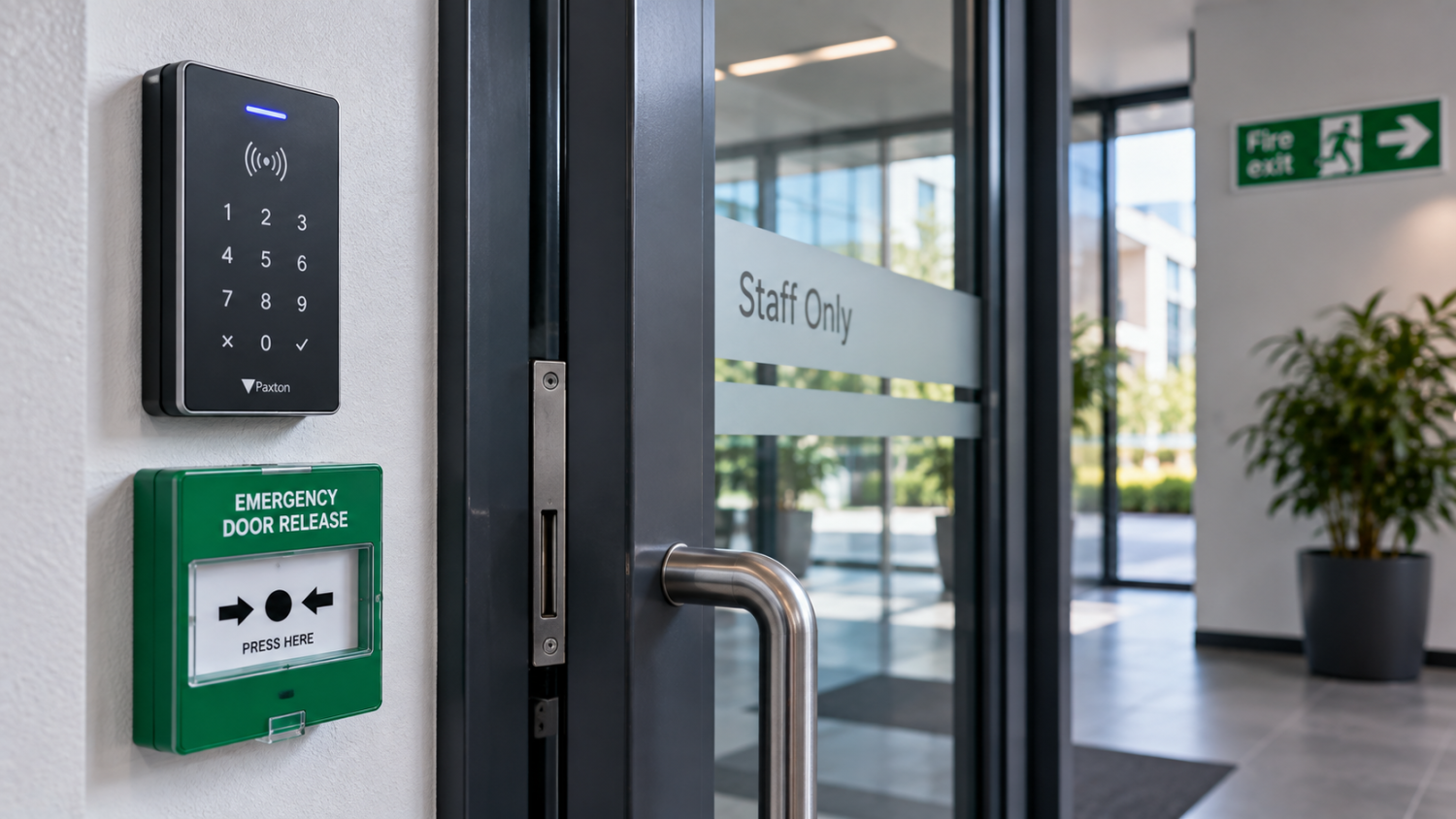
Where an access-controlled door forms part of an escape route, the security system must not prevent people from escaping safely during a fire. Depending on the door, locking arrangement and building fire strategy, this can mean electrically controlled locks releasing automatically when the fire alarm operates, alongside suitable manual escape or emergency-release arrangements.
However, not every access-controlled door should behave in exactly the same way. A secure office entrance, an internal restricted-area door and a final escape door can have very different requirements. The correct arrangement needs to be designed around the building, its occupants and its fire strategy.
For businesses, landlords and property managers across Horley, Reigate, Redhill, Crawley, Surrey and West Sussex, this guide explains:
- How access control and fire safety interact
- Why access control should not obstruct escape
- What fail-safe door locking means
- When a fire alarm may release a controlled door
- What green emergency door-release units do
- What happens during a power failure
- How fire doors differ from ordinary security doors
- Why magnetic locks need careful design
- How systems should be tested and maintained
- How JPEC Fire & Security can help
Why does access control affect fire safety?
Access control is designed to restrict entry. Fire-safety arrangements need to ensure people can escape when necessary.
Those two objectives can conflict if the door system is not designed correctly.
A card reader, keypad, fob system or electronic lock may provide excellent security during normal operation, but people inside the building still need an appropriate means of escape during an emergency.
This becomes particularly important where an electrically locked door is located on an escape route.
Security should therefore be designed around the building’s fire-safety requirements rather than added independently afterwards.
Should access-controlled doors unlock when the fire alarm operates?
Some should, but the correct arrangement depends on the door and the building design.
Electrically controlled doors forming part of an escape route may require an interface with the fire detection and alarm system so that the locking mechanism releases when the fire alarm operates.
That does not mean every electronically controlled door throughout a building should automatically unlock whenever the alarm sounds.
The required behaviour should be established from the fire strategy, escape arrangements, risk assessment and door function.
This is why access control and fire alarm interfaces should be designed rather than improvised on site.
What is a fail-safe door lock?
In this context, fail-safe generally means the electrically controlled locking arrangement releases to allow escape when electrical power is removed.
Electromagnetic locks are a common example because the magnet requires electrical power to remain locked.
If the appropriate power supply to the magnet is interrupted, the locking force is removed.
This characteristic can be useful for doors where safe escape requires the electronic lock to release during particular fault or emergency conditions.
However, selecting a fail-safe lock is only one part of the design. The complete door, controls, interfaces and escape arrangements need to operate correctly together.
What is a fail-secure lock?
A fail-secure locking device behaves differently and can remain secure when electrical power is lost.
This may be desirable for certain security applications, but it creates different considerations if the door is also part of an escape route.
It is therefore important not to choose between fail-safe and fail-secure equipment based only on which option sounds more secure.
The correct locking arrangement depends on what the door is protecting, which direction people need to travel, the means of escape and the relevant fire-safety requirements.
What is the green break-glass unit next to an access-controlled door?
Many people recognise the red manual call point used to raise a fire alarm. The green unit commonly seen beside an access-controlled door performs a different function.
It is generally used as an emergency door-release device.
Operating it can interrupt the electrical locking circuit so that the relevant door can be released independently of normal access credentials.
The precise arrangement depends on the system design.
It should not be confused with a fire alarm manual call point, and it should not be casually removed, obstructed or relocated when a doorway is refurbished.
Is pressing the green door release the same as setting off the fire alarm?
No.
A door-release unit is intended to release the relevant controlled locking arrangement. A fire alarm manual call point is intended to raise the fire alarm.
They perform different functions even though both may use a break-glass or resettable operating element.
Clear positioning, suitable equipment and appropriate signage help occupants understand what each device is for.
The system should be designed so emergency escape does not depend on somebody having to understand a complicated sequence of security controls.
What happens to a magnetic lock during a fire?
Where an electromagnetic lock is designed to release as part of the fire-safety arrangement, the system can interrupt power to the magnet when the relevant fire alarm condition occurs.
The magnet then stops holding the door locked.
Government fire-safety guidance recognises electromagnetic locking devices and explains that release can be controlled by interrupting their electrical supply, including through an interface with the fire warning or detection system.
The complete arrangement still needs to be appropriate for that particular escape door.
What happens if the power fails?
The behaviour depends on the locking equipment and system design.
A fail-safe electromagnetic locking arrangement will normally release when its power is removed.
Other locking technologies may behave differently.
Power supplies can also incorporate battery backup, meaning a simple loss of mains electricity does not necessarily remove power from every access-control component immediately.
The required response to mains failure, system faults and emergency operation therefore needs to be considered during design and commissioning.
Does battery backup mean a magnetic lock stays locked during a power cut?
Not necessarily.
Battery-backed access-control equipment can maintain system operation during a mains failure, but the door-release arrangements still need to provide the required means of escape.
The fire-safety design should not rely on somebody waiting for a backup battery to run flat before an escape door becomes usable.
The power supply, fire alarm interface, emergency-release controls and locking equipment need to be coordinated as one system.
Can a card reader or keypad be used on a fire exit?
Controlling entry from one side of a door does not necessarily mean that people escaping from the other side should need a card, fob or code.
Government fire-safety guidance makes an important distinction between access control and exit control.
Many systems can restrict people entering a secure area while retaining an immediate means of escape for people leaving it.
Where a door forms part of an escape route, the way occupants release and open it needs to be appropriate for the premises and the people who may use it.
Visitors and members of the public may require different considerations from a small number of trained staff familiar with the building.
Should you ever need a fob to escape from a building?
A means of escape should not depend on somebody finding a normal access credential during an emergency where the fire-safety design requires immediate escape through that door.
The correct exit hardware depends on the premises, occupancy and door.
For example, some doors may use panic hardware, others may use emergency exit devices, and electrically controlled arrangements may incorporate suitable override and release mechanisms.
The key point is that the security system must not introduce an unacceptable obstacle to escape.
What is the difference between access control and exit control?
Access control restricts who can enter a building or secure area.
Exit control restricts or influences how people can leave.
The distinction matters because controlling unauthorised entry is normally a security objective, while restricting exit can directly affect means of escape.
A door can therefore require a fob to enter while still allowing straightforward escape from the secure side.
Where exit itself needs to be controlled, the fire-safety implications require particularly careful assessment.
Can there be a delay before an access-controlled door releases?
Time-delayed exit arrangements exist, but they are not suitable for every environment.
Government guidance notes particular concerns about delays where members of the public are present and explains that any use of electronic exit-control arrangements should be supported by suitable risk assessment and management controls.
A delay should therefore never be added simply because a business wants additional security.
Its suitability needs to be established for the individual premises and occupants.
What about access-controlled fire doors?
A fire door and an access-controlled door can be the same physical door, but the two functions need to work together.
The fire door may be required to resist the spread of fire and smoke, while the access-control equipment manages who can pass through it during normal operation.
Adding locks, readers, door contacts, cables or other equipment should not undermine the fire-resisting performance or required operation of the door assembly.
Where the door needs to close during a fire, the security equipment must not prevent that from happening.
Fire-door requirements and access-control requirements should therefore be coordinated from the beginning.
Is a door held open by an electromagnet the same as an access-control lock?
No. They can use similar electromagnetic principles but perform different jobs.
An electromagnetic door hold-open device allows a fire-resisting door to remain open during normal conditions and releases it when required so the self-closing mechanism can close the door.
An electromagnetic security lock holds a door locked to control access.
Both may interact with a fire detection and alarm system, but the intended response is different.
One releases so the fire door can close. The other may release so people can escape through the door.
Can the fire alarm and access control be connected together?
Yes. Where required by the fire strategy and system design, an interface can allow the fire alarm system to initiate the appropriate response from access-controlled doors.
This needs to be done properly.
The design should establish:
- which doors are affected
- what event causes release
- how the locking power is interrupted
- what happens during a system fault
- what happens during mains failure
- what manual override is provided
- how the arrangement is reset afterwards
These details form part of the overall cause-and-effect operation of the building’s fire and security systems.
What is BS 7273-4?
BS 7273-4 is a British Standard concerned with the actuation of door-release mechanisms in connection with fire protection measures.
It provides recommendations relating to the design, installation, commissioning and maintenance of electrical control arrangements that release, unlock or open doors in the event of fire.
It is particularly relevant where fire detection and alarm systems interface with door hardware.
A British Standard is not automatically the same thing as legislation. However, standards can provide an important recognised technical framework for designing and maintaining appropriate systems.
Does every access-controlled door need a fire alarm interface?
No.
The need for an interface depends on the door’s function and the building’s fire-safety design.
A controlled door that does not affect means of escape can present different requirements from a locked final exit or a controlled door positioned directly on an escape route.
Automatically linking every security door to the fire alarm without understanding the building could also create security or operational problems.
The required interfaces should therefore be identified during system design.
What happens to access control after the fire alarm is reset?
The system should return to its normal secure operating condition in accordance with its design and appropriate reset procedure.
Exactly how this happens depends on the equipment and interfaces installed.
A building should not be left unintentionally insecure because nobody understands how the access-control system responds after a fire alarm activation.
Handover information and staff training should therefore cover normal operation as well as emergency behaviour.
Should access-controlled doors be tested during fire alarm servicing?
Where doors form part of the fire alarm’s cause-and-effect operation, the interfaces need appropriate testing and maintenance.
Testing only the audible alarm while ignoring connected door releases can miss an important part of the building’s fire-safety operation.
The appropriate test regime depends on the system, fire strategy and relevant standards.
Access-control equipment itself also requires ongoing maintenance because locks, readers, door contacts, power supplies and mechanical components can develop faults over time.
What if the building has been refurbished?
Refurbishment is a good time to reassess access control and fire-safety interfaces.
New partitions, relocated doors, changes to escape routes or different occupancy arrangements can all affect the original design.
Problems can arise when a contractor changes a door or security system without recognising that it forms part of the building’s fire strategy.
The fire alarm, access control, door hardware and escape arrangements should therefore be considered together when relevant areas of a building are altered.
Can access control integrate with CCTV and intercom systems?
Yes. Access control can be integrated with compatible security systems where appropriate.
For example, video door entry can allow reception staff or occupants to identify a visitor before granting access, while CCTV can provide additional visual coverage around entrances.
Integration can make security easier to manage, but it should not make emergency escape more complicated.
JPEC Fire & Security can consider access control, CCTV, intercom and fire-safety requirements together when designing a system.
JPEC Fire & Security can help
JPEC Fire & Security designs, installs, commissions, services and maintains access-control and fire-safety systems for businesses, landlords and managed properties across Horley, Reigate, Redhill, Crawley, Surrey, West Sussex and surrounding areas.
Our access-control services include keypad, card and fob systems, single-door and multi-door installations, audio and video door entry, electric locking, controlled door release and integration with compatible security systems.
Where controlled doors interact with escape routes or fire-safety measures, we can assess the proposed arrangement alongside the building’s fire alarm requirements and relevant fire strategy.
JPEC Fire & Security also provides fire alarm systems, emergency lighting, AOV and smoke-control systems, CCTV, intruder alarms and fire risk assessments.
Whether you are installing access control for the first time, extending an existing system or refurbishing a building containing controlled doors, the objective is to provide practical security without compromising fire safety.
To discuss an access-control system or fire alarm interface, contact JPEC Fire & Security.
This article provides general information and is not a substitute for a property-specific fire risk assessment, fire strategy, access-control design or legal advice. Door-release and escape arrangements should be confirmed for the individual premises by appropriately competent professionals.