Emergency lighting should be checked regularly to make sure it will operate when the normal lighting supply fails. In most UK premises, this normally involves brief functional checks at regular intervals and a full-duration test at least annually, with the exact testing and maintenance arrangements depending on the system and premises.
For businesses, landlords, responsible persons and property managers, simply having emergency lights installed is not enough. The system needs to remain operational, batteries need to retain sufficient capacity and faults need to be identified before an emergency occurs.
In this guide, we explain:
- Why emergency lighting needs testing
- How often functional checks should be carried out
- What happens during an annual duration test
- How long emergency lights should remain illuminated
- Who can carry out the different checks
- What should be recorded in the fire safety logbook
- Common emergency lighting faults
- When professional maintenance is needed
- What happens after changes to a building
- How JPEC Fire & Security can help
Why does emergency lighting need to be tested?
Emergency lighting is designed to operate if the normal lighting supply fails.
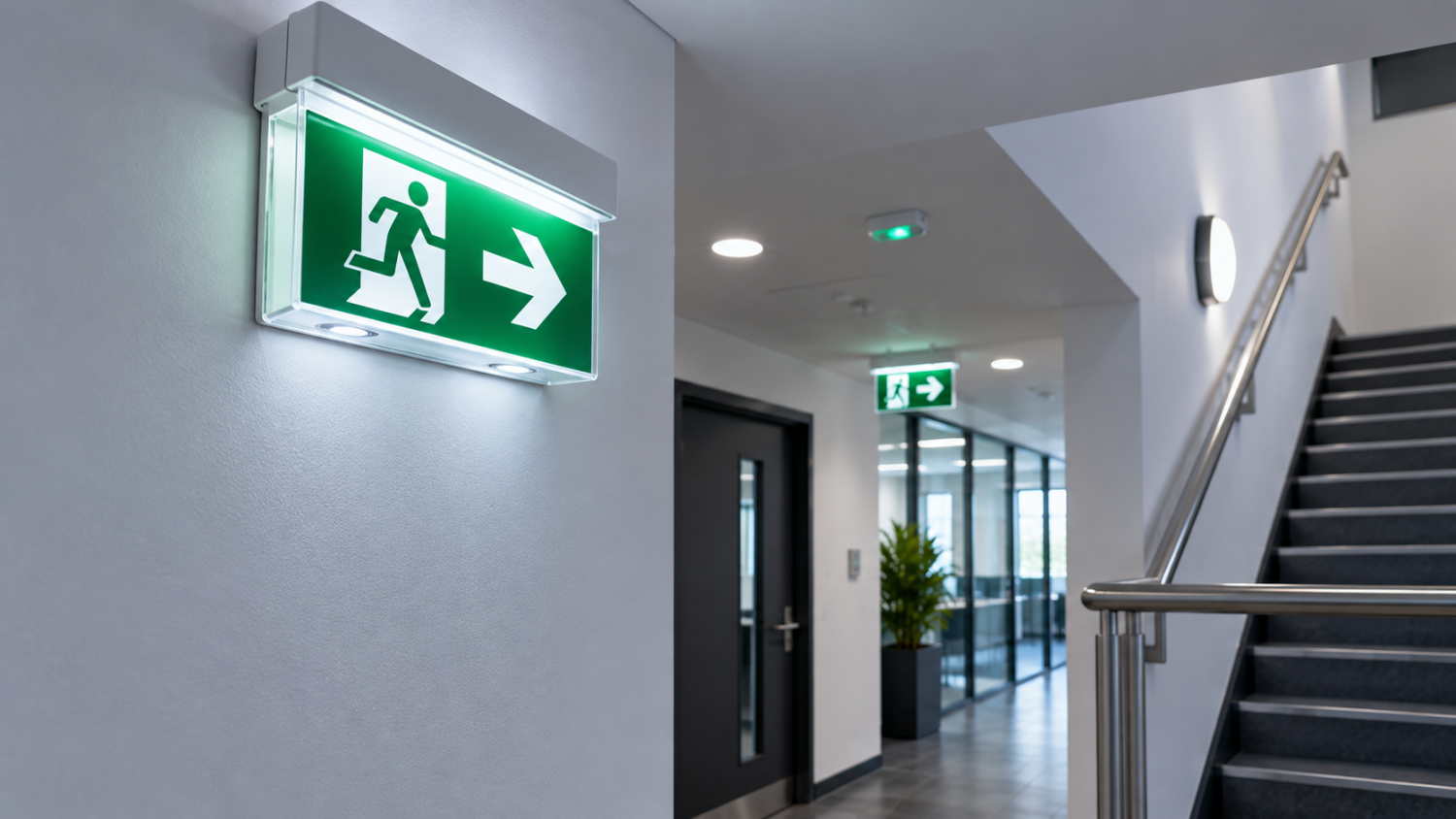
Its purpose can include illuminating escape routes, stairs, changes of level, exits, fire alarm call points, firefighting equipment and other important areas so occupants can leave the building safely.
Because emergency lighting may spend most of its life operating in standby mode, a fault may not be obvious during normal day-to-day use.
Regular testing helps confirm that the luminaires, batteries, charging arrangements and associated controls are still working correctly.
How often should emergency lighting be tested?
Emergency lighting systems are normally subject to regular functional testing together with a longer full-duration test.
BS 5266-1 provides guidance for emergency lighting in premises, while BS EN 50172 covers emergency escape lighting systems and includes inspection and testing arrangements.
In practice, the testing programme commonly includes:
- routine visual checks
- short functional tests, commonly carried out monthly
- a full rated-duration test, commonly carried out annually
The appropriate regime should reflect the system installed and the fire safety arrangements for the individual premises.
What is a monthly emergency lighting test?
A monthly test is normally a short functional check designed to confirm that emergency luminaires operate when the normal lighting supply is simulated as having failed.
The test does not normally involve leaving every emergency light running until its battery is exhausted.
Instead, the aim is to confirm that each relevant luminaire changes into emergency operation and illuminates correctly.
After the test, the normal supply is restored and any obvious faults should be recorded and investigated.
Does every emergency light need to be checked?
The testing arrangement should allow the emergency lighting installation to be properly assessed rather than checking one convenient fitting and assuming the rest are working.
Individual luminaires can fail for different reasons.
A battery may deteriorate, a lamp or LED module may fail, a charging circuit may develop a fault or a fitting may be damaged.
For larger premises, having an accurate schedule or drawing showing the emergency luminaires can make routine inspection and maintenance considerably easier.
What is an annual emergency lighting duration test?
The annual test is more substantial than the regular functional check.
The emergency lighting is operated under simulated mains-failure conditions for its required rated duration so that the condition of the system and its batteries can be assessed.
A fitting that illuminates successfully for a few minutes during a monthly check may still have a deteriorated battery that cannot maintain output for the full required period.
This is why the longer duration test is important.
How long should emergency lighting stay on?
The required duration depends on the design and use of the premises.
Three-hour emergency lighting is common in many UK buildings, but the correct duration should be determined from the applicable design requirements rather than assumed for every property.
The emergency lighting design needs to consider how occupants will escape and whether the building may need to remain evacuated until normal lighting has been restored.
The installed system should therefore be tested against the duration for which it was designed.
Why shouldn’t a full-duration test be carried out at a bad time?
A full-duration test discharges the emergency lighting batteries.
Immediately afterwards, the system may need time to recharge before its full emergency duration is available again.
That means timing matters.
For example, fully discharging emergency lighting immediately before a busy evening period could leave the premises with reduced emergency-lighting capability while the batteries recharge.
Professional testing can therefore be planned around the way the building is occupied and operated.
Who is responsible for emergency lighting?
For workplaces and relevant non-domestic premises in England and Wales, fire safety duties generally sit with the responsible person under the Regulatory Reform (Fire Safety) Order 2005.
The responsible person needs to ensure that fire precautions are appropriately maintained and that the premises remain safe.
The person responsible will depend on the type of building and how it is occupied or managed.
It could be an employer, building owner, landlord, managing agent or another person with control of the premises.
Is monthly emergency lighting testing a legal requirement?
It is important to distinguish legislation from the technical standards used to demonstrate good fire-safety practice.
The Fire Safety Order places duties on responsible persons to provide and maintain appropriate fire precautions where required.
British Standards such as BS 5266 provide recognised guidance on emergency lighting design, installation, testing and maintenance.
A British Standard is not automatically the same thing as an Act of Parliament or statutory regulation.
However, following appropriate recognised standards can be an important way of demonstrating that fire-safety systems have been properly managed.
Can staff carry out the monthly test?
For some systems, a suitably instructed member of staff may be able to perform a straightforward routine functional test using the appropriate test arrangement.
That does not mean untrained staff should dismantle luminaires, access live electrical equipment or attempt electrical repairs.
The person carrying out the check should understand what they are testing, what successful operation looks like and what to do if a fault is discovered.
More detailed inspection, fault diagnosis, repairs and periodic professional maintenance should be carried out by appropriately competent people.
How are emergency lights tested?
The method depends on the installation.
Some systems have dedicated test switches that allow the normal supply to emergency luminaires to be interrupted without affecting unrelated lighting.
Other buildings may use automatic testing or centrally monitored emergency lighting systems.
The testing method should be understood before anybody operates switches or protective devices.
Randomly turning off circuits at a distribution board is not an appropriate substitute for understanding how the emergency lighting installation has been designed.
What is a test key switch?
A test key switch can provide a controlled way of simulating a failure of the normal lighting supply to emergency luminaires.
This allows the emergency function to be checked without unnecessarily isolating other electrical equipment.
The exact arrangement varies between installations.
Where a building has several lighting areas or floors, there may be multiple test points rather than one switch controlling the entire emergency lighting system.
What should happen during a monthly check?
The person carrying out the check should confirm that the relevant emergency luminaires operate correctly when the normal supply is interrupted.
They should look for obvious problems such as:
- a fitting that does not illuminate
- very weak light output
- physical damage
- missing or damaged exit signage
- fault indicators
- lights that do not return to normal operation correctly
Any defects should be recorded and appropriate remedial action arranged.
What should be recorded after an emergency lighting test?
Testing and maintenance records form an important part of managing the fire-safety systems within a building.
The record should make it clear when the test was carried out and whether faults were identified.
Where defects are found, the subsequent repair or remedial action should also be traceable.
Many premises keep these records within a fire safety logbook alongside information about fire alarm tests, servicing and other fire-safety checks.
Accurate records can also help identify repeat failures or ageing equipment.
What are common emergency lighting faults?
Emergency lighting systems can develop several types of fault as they age.
Common examples include:
- failed or deteriorated batteries
- damaged luminaires
- failed LED modules or lamps
- charging faults
- incorrect indicator lights
- damaged test switches
- poorly positioned replacement fittings
- missing or inappropriate exit signs
A fitting illuminating during a short test does not necessarily prove that its battery will support the required full duration.
How long do emergency lighting batteries last?
Battery life varies according to the equipment, environment, charging conditions, temperature, maintenance and frequency of discharge.
They should therefore be assessed by condition and performance rather than replaced solely because somebody remembers the installation being a particular age.
Duration testing is particularly useful because a deteriorating battery may appear normal while connected to mains power but fail to sustain emergency operation for long enough.
Where batteries repeatedly fail testing, replacement equipment or battery replacement may be required depending on the luminaire design.
Do LED emergency lights still need testing?
Yes.
LED technology can provide long lamp life and efficient operation, but it does not remove the need to test the emergency function.
The battery, charger, control electronics and other components still need to work when the normal supply fails.
An LED emergency luminaire can therefore look perfectly normal during everyday use while still having a fault that affects its emergency performance.
Do illuminated exit signs need testing too?
Where illuminated exit signs form part of the emergency lighting installation, their emergency operation also needs to remain effective.
The sign needs to be visible and appropriately positioned so occupants can understand the direction of escape.
A sign that is damaged, obscured, incorrectly positioned or unable to operate during a power failure may not perform its intended function.
Changes to partitions, corridors or escape routes can also mean that previously suitable signage needs to be reviewed.
What if an emergency light fails the test?
The fault should not simply be ignored until the next scheduled test.
The significance of the failed fitting depends partly on its location and the wider emergency lighting design.
A failure beside a final exit, staircase or important change of direction may have a different immediate impact from a fitting in an area with additional coverage.
The defect should be recorded and assessed so that appropriate remedial work can be arranged.
If several fittings fail together, this can indicate a wider maintenance issue.
Should emergency lighting be reviewed after a refurbishment?
Yes.
Changing the internal layout of a building can change the escape routes and therefore the emergency lighting requirements.
New walls, doors, corridors, stair arrangements, changes of use or alterations to fire-safety equipment can all affect whether the existing coverage remains suitable.
Simply leaving the original emergency lights in place after a major refurbishment does not prove that the new layout is adequately covered.
The system should be reviewed as part of the wider fire-safety planning for the works.
Does emergency lighting need to cover fire alarm call points and equipment?
Emergency lighting design considers more than simply illuminating the middle of an escape corridor.
Relevant points can include changes of direction, stairs, exits, intersections and locations of important fire-safety equipment.
The exact design needs to be assessed for the individual premises.
This is why emergency lighting is better designed from a survey and fire-safety information than by simply installing fittings at regular distances along a ceiling.
What about emergency lighting in toilets and other rooms?
Whether a particular room requires emergency lighting depends on factors including its size, use, layout and the applicable guidance.
Windowless areas, accessible facilities, plant areas and other spaces can require particular consideration.
The requirements should be determined as part of the emergency lighting design rather than assuming that only corridors and staircases matter.
A survey can identify where emergency illumination is needed across the premises.
Do small businesses still need emergency lighting tests?
The size of the business alone does not determine whether testing is necessary.
If emergency lighting has been provided as part of the building’s fire precautions, it needs to remain operational.
A small shop in Horley, an office in Reigate or a workshop near Crawley can still have escape routes that rely on emergency illumination during a power failure.
The testing arrangement should be proportionate to the actual system and premises.
What about landlords and communal areas?
Landlords and managing agents may be responsible for emergency lighting within relevant communal areas depending on the building and management arrangements.
Staircases, corridors and final exits need particular attention because residents or occupants may rely on them during an emergency.
The applicable fire-safety duties differ according to the type and use of the building, so responsibilities should be established clearly rather than assumed.
Where emergency lighting is installed, appropriate testing and maintenance records should be maintained.
Can emergency lighting testing be combined with fire alarm servicing?
They are different systems and have different testing requirements, but businesses often find it easier to coordinate their wider fire-safety maintenance.
For example, professional emergency lighting inspection can be planned alongside fire alarm servicing where appropriate.
This can help property managers keep records organised and reduce the risk of one system being overlooked.
It does not mean that the routine checks required between professional visits should be ignored.
Should old emergency lights be upgraded?
Age alone does not necessarily mean every luminaire needs immediate replacement, but older equipment can become less reliable and harder to maintain.
Signs that an upgrade may be worth considering include repeated battery failures, damaged fittings, poor light output, obsolete replacement parts or significant changes to the building layout.
Modern LED emergency luminaires can also reduce normal energy use where maintained fittings operate continuously.
A survey can establish whether targeted repairs or a wider upgrade is the more sensible option.
How do I know whether my emergency lighting is adequate?
Passing a functional test only confirms part of the picture.
The system also needs to have been appropriately designed and positioned for the building and its escape routes.
If the premises has been altered, the use has changed or there is no reliable information about the original emergency lighting design, a professional survey may be worthwhile.
JPEC Fire & Security can assess the existing installation, identify obvious deficiencies and advise on testing, maintenance or upgrades where required.
JPEC Fire & Security can help
JPEC Fire & Security can inspect, test, maintain, repair and install emergency lighting systems for businesses, landlords, property managers and organisations across Horley, Reigate, Redhill, Crawley, Surrey, West Sussex and surrounding areas.
We can assess existing emergency lighting, carry out professional testing, identify failed fittings and batteries and advise where changes to the premises mean the existing coverage should be reviewed.
Where a new or replacement system is required, we can design and install emergency lighting around the actual building layout and escape routes rather than relying on a generic arrangement.
We can also coordinate emergency lighting with other fire and security requirements, including fire alarms, fire risk assessment actions, AOV systems, access control and associated electrical work where appropriate.
To arrange emergency lighting testing, maintenance or a survey, contact JPEC Fire & Security.
This article provides general information and is not a substitute for a site-specific fire risk assessment or emergency lighting design. Requirements depend on the premises, its use, escape routes and applicable fire-safety arrangements. Testing and maintenance should be carried out by appropriately competent people where required.