
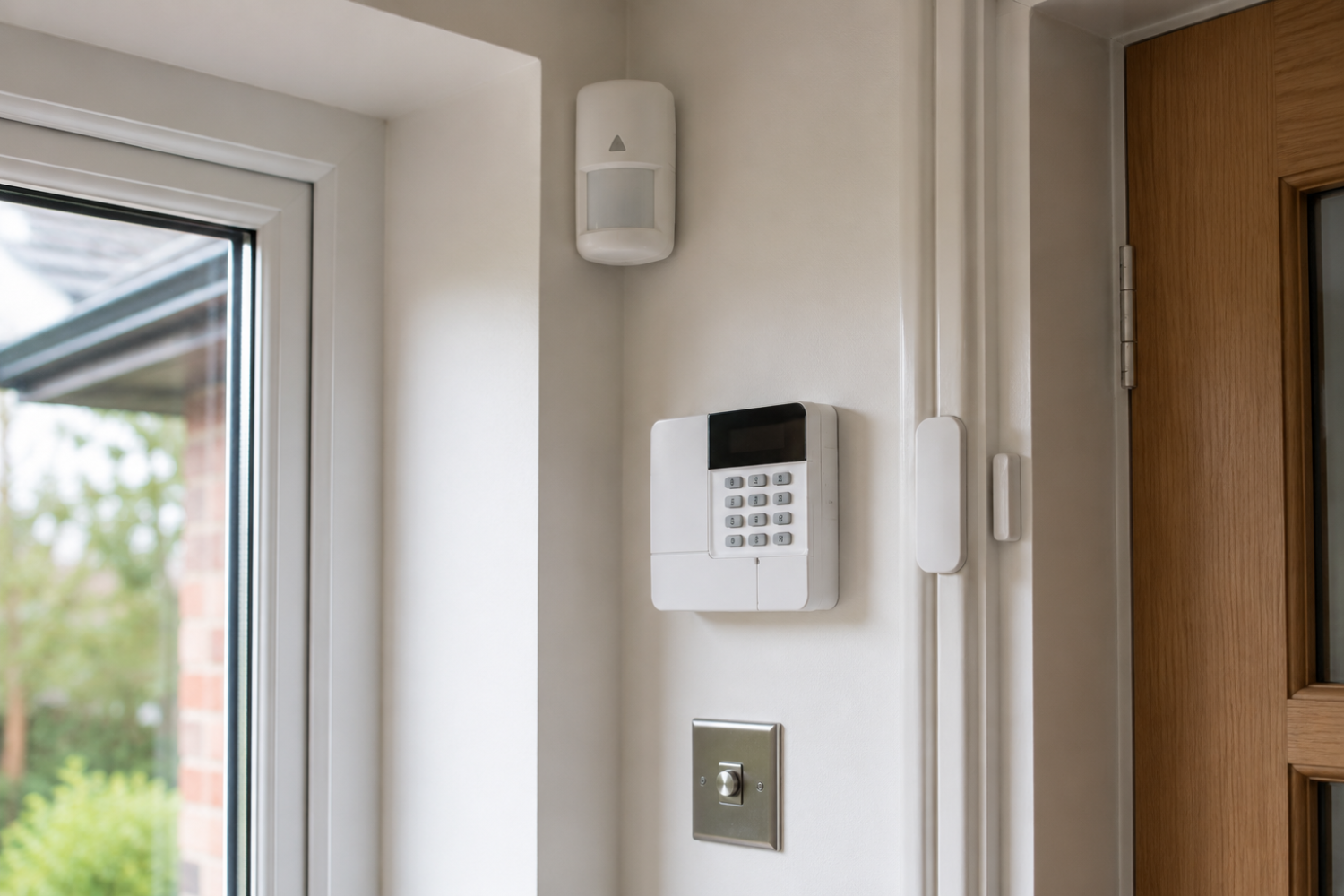
Intruder alarm installation is the process of fitting a security system that detects unwanted entry and raises an alert if someone breaks in or attempts to access your property. For homes, landlords and small businesses across Surrey and West Sussex, a well-designed intruder alarm can help deter burglary, protect valuables and give you more confidence when the building is empty.
This guide explains what an intruder alarm does, what types are available, what installation involves and how to avoid common mistakes. We will cover:
- What an intruder alarm is
- How intruder alarms work
- Who needs an intruder alarm
- Wired versus wireless alarms
- What alarm grades mean
- What installation involves
- How much disruption to expect
- What can go wrong
- What maintenance is needed
- Common mistakes to avoid
- What to check before choosing an installer
- JPEC Fire and Security can help
What is an intruder alarm?
An intruder alarm is a system that detects movement, door opening, glass breakage or other signs of unwanted entry. If triggered, it can sound an alarm, notify you, alert a monitoring centre or activate other security responses depending on the system design.
An intruder alarm is not the same as CCTV. CCTV records and helps you see what happened. An intruder alarm actively detects a possible break-in and raises an alert at the time.
For many properties, the best security setup uses more than one measure. Good locks, doors, lighting, CCTV and an intruder alarm can all work together.
How does an intruder alarm work?
An intruder alarm works by using sensors connected to a control panel. When the system is set and a sensor is triggered, the control panel decides whether to activate the alarm.
A typical alarm system may include:
- Door contacts, which detect when a door opens
- Movement sensors, which detect movement inside a room
- Shock sensors, which detect impact on doors or windows
- A control panel, which is the main brain of the system
- A keypad or app for setting and unsetting the alarm
- An external sounder on the outside of the property
- Internal sounders or alerts
- Backup battery support
Some systems can also send alerts to your phone or connect to a monitoring service. Monitoring means alerts are sent to a professional alarm receiving centre, rather than relying only on a siren or app notification.
Who needs an intruder alarm?
An intruder alarm is worth considering if your property has valuables, vulnerable access points, periods when it is empty, or previous security concerns. It can be useful for both homes and businesses.
A homeowner in Horley may want an alarm for a driveway, garage, rear door and ground-floor rooms. A small shop in Redhill may need protection for the entrance, stockroom and till area. A business unit in Crawley may need an alarm that protects shutters, offices, warehouse space and out-of-hours access.
An intruder alarm may suit:
- Homes with side gates, rear access or outbuildings
- Shops, salons, offices and small businesses
- Warehouses and workshops
- Landlords managing empty or shared buildings
- Properties storing tools, stock or equipment
- Sites with previous attempted break-ins
- Businesses with insurance requirements
It may not be the first priority if basic physical security is poor. If doors, windows or locks are weak, those should be reviewed as well.
JPEC Fire and Security can survey homes and businesses across Horley, Reigate, Redhill, Crawley, Surrey and West Sussex and explain what type of alarm setup is suitable for the property.
Should you choose a wired or wireless intruder alarm?
Both wired and wireless intruder alarms can work well when designed and installed properly. The best choice depends on the building, access, budget and how much disruption you want to avoid.
A wired alarm uses cables between the control panel, sensors and other equipment. It can be very reliable and is often a good option for new builds, refurbishments or commercial premises where cable routes are available.
A wireless alarm uses radio signals between the devices and the control panel. It can be quicker to install and usually causes less disruption, especially in finished homes or buildings where running cables would be difficult.
The trade-off is that wireless devices rely on batteries, so battery monitoring and maintenance matter. Wired systems may involve more installation work, but they reduce the number of device batteries that need replacing.
There is no single best answer. A professional survey can explain what makes sense for your building.
What do intruder alarm grades mean?
An alarm grade is a security level used to describe how resistant a system is to different types of intruder risk. In the UK, intruder alarm systems are commonly designed around BS EN 50131 and PD 6662, which are standards used in the security industry.
In plain English, the higher the grade, the higher the expected risk and the more robust the system needs to be.
For many homes and small businesses, the installer will recommend a suitable grade based on the property, contents, risk level and any insurer requirements. You do not need to become an expert in alarm standards, but you should understand that not every alarm system is equal.
Insurers may sometimes specify a particular alarm grade, monitoring type or approved installation route. If your insurer has requirements, check them before installation, not after.
What does intruder alarm installation involve?
Intruder alarm installation usually starts with a survey. The installer looks at the building layout, doors, windows, likely entry points, valuables, user needs and how the system will be set and unset.
A typical installation may involve:
- Site survey and security advice
- Choosing wired, wireless or hybrid equipment
- Planning sensor positions
- Installing the control panel and keypad
- Fitting door contacts and movement sensors
- Installing internal or external sounders
- Setting up app control or monitoring if required
- Testing the system
- User handover and training
A hybrid system means a mix of wired and wireless devices. This can be useful where some cable routes are easy and others are not.
Commissioning means the final setup and testing after installation. This is where the installer checks that each sensor works correctly, the alarm activates as expected and you know how to use the system.
JPEC Fire and Security can survey, design, install, commission and maintain intruder alarms, while explaining the options and trade-offs in plain English.
How much disruption should you expect?
Intruder alarm installation is usually manageable, especially for smaller homes and businesses. The disruption depends on the type of system, the number of devices, cable routes and access.
Wireless systems usually cause less disruption because there is less cabling. Wired systems may involve lifting floorboards, routing cables, drilling or accessing lofts, ceilings and cupboards. In commercial buildings, installation may need to be planned around opening hours or staff access.
For a small home in Reigate, installation may be fairly straightforward. For a larger business in Crawley with multiple offices, shutters and storage areas, it may need more planning.
Good preparation helps. Make sure the installer can access key rooms, cupboards, loft spaces, entry points and power locations.
What can go wrong with intruder alarms?
Most alarm problems come from poor design, poor installation, user error or lack of maintenance. A good system should be reliable, easy to use and designed around the way you actually use the building.
Common problems include false alarms, weak batteries, badly positioned sensors, poor Wi-Fi or signal strength, damaged contacts, incorrect user codes and confusion over how to set or unset the system.
Pets can also be an issue if sensors are not chosen or positioned properly. If you have dogs, cats or other pets, tell your installer during the survey.
An alarm that is difficult to use is more likely to be ignored. Simplicity matters.
What maintenance is needed?
Intruder alarms should be checked and maintained so they stay reliable. The maintenance frequency depends on the type of system, whether it is monitored, manufacturer guidance and any insurer requirements.
Maintenance may include checking sensors, batteries, sirens, control panels, keypads, app connections, fault logs and signal paths. For monitored systems, communication links may also need testing.
Wireless systems may need battery replacements in devices. Wired systems still need checks, especially on backup batteries, sounders and system faults.
For businesses and landlords in Surrey and West Sussex, planned maintenance can help reduce nuisance alarms and show that the system is being looked after properly.
What are common mistakes to avoid?
The biggest mistake is buying an alarm based only on price without thinking about the property risk. A cheap system in the wrong places may not protect the areas that matter.
Other common mistakes include fitting too few sensors, ignoring rear access, not thinking about pets, relying only on a siren, choosing poor app-based systems, forgetting about maintenance and not checking insurance requirements.
Avoid these common problems:
- Not surveying the property first
- Poor sensor positioning
- No backup power
- No plan for false alarms
- Weak user codes
- No maintenance checks
- Cameras or alarms covering the wrong areas
- Assuming wireless means no maintenance
A good alarm should fit your property and daily routine. It should protect the right areas without becoming a nuisance.
What should you check before choosing an installer?
Choose an installer who asks questions before recommending equipment. They should want to understand your building, your risk, how you use the property and what you expect from the system.
Before choosing an installer, ask:
- What areas should the alarm cover?
- Is wired, wireless or hybrid best for this property?
- Will the system suit pets or regular visitors?
- Can it be controlled by an app?
- What happens during a power cut?
- Is monitoring needed?
- What maintenance is recommended?
- Will I receive clear handover instructions?
For business premises, also ask whether the system meets any insurer requirements. For homes, ask how the system will fit around everyday use so it does not become frustrating.
A good installer should be honest. Not every property needs the most expensive system, but every property does need a system that is properly designed.
Practical tips before you commit
Before arranging installation, walk around your property and think like someone trying to get in. Look at front doors, back doors, side gates, ground-floor windows, garages, outbuildings, stockrooms and quiet access points.
Think about how you use the building. Do you have staff arriving at different times? Do cleaners need access? Are pets left inside? Do you want alerts on your phone? Do you need part-setting at night, where only certain areas are alarmed while you are still inside?
If your property is in Horley, Reigate, Redhill or Crawley, a local survey can help pick up practical issues such as building layout, cable routes, signal strength, external sounder position and whether CCTV or access control should also be considered.
The best next step is usually a site survey. That allows the advice to be based on your actual building, not a generic package.
JPEC Fire and Security can help
JPEC Fire and Security can help with intruder alarm surveys, design advice, installation, commissioning, servicing, maintenance and fault support for homes, landlords, property managers and businesses.
If you are based in Horley, Reigate, Redhill, Crawley, Surrey or West Sussex, get in touch with JPEC Fire and Security for a survey, design advice, servicing advice, maintenance support or a proper quote based on your property and requirements.
This article is general information only and is not personal fire safety, security or legal advice. Recommendations should always be confirmed through a proper survey, insurer requirements where relevant, and system design based on your specific site and needs.